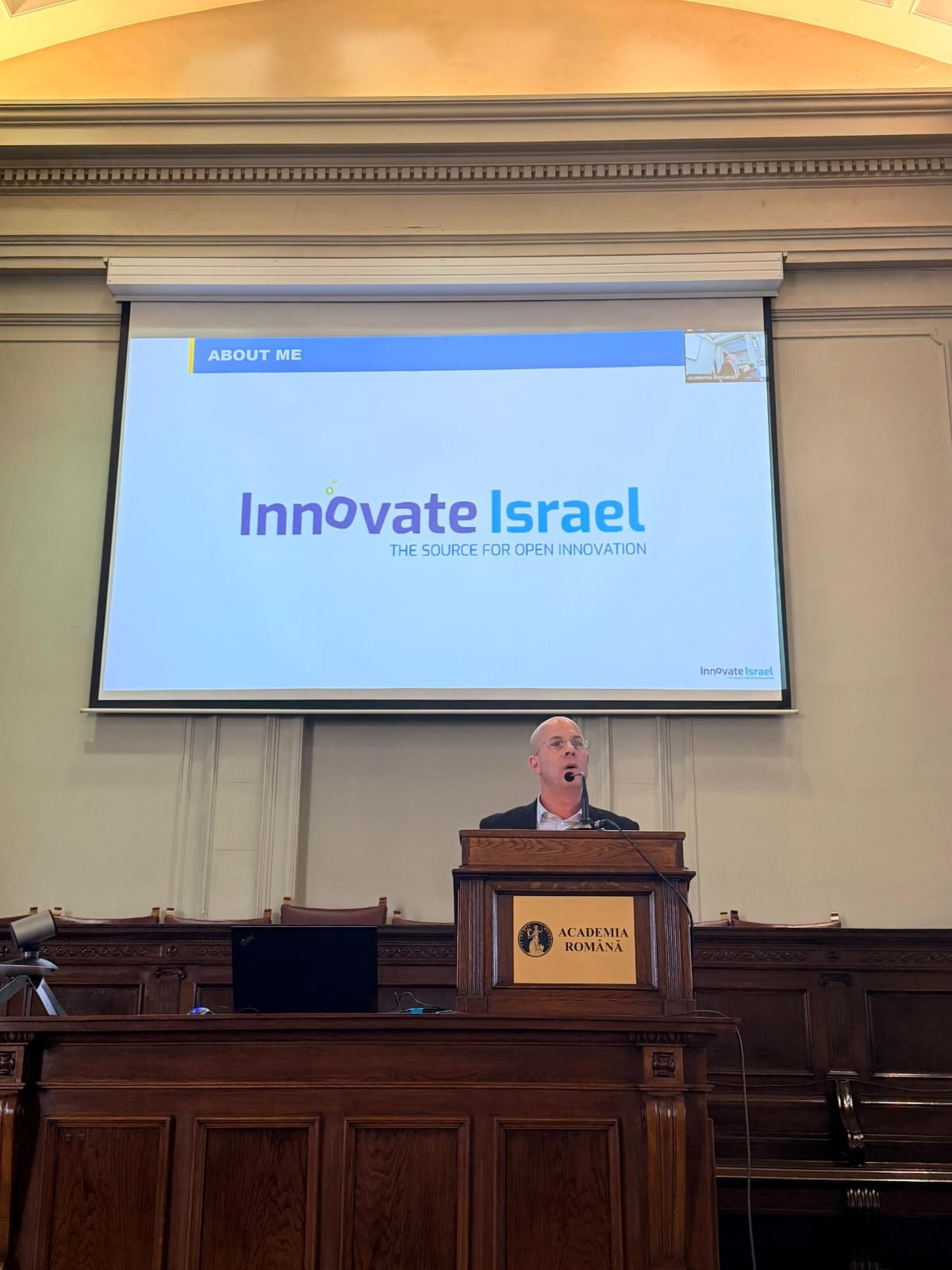
Interview with Itai Green, Global innovation expert, entrepreneur, author of INNOVATION or ELIMINATION, and founder of Global Innovation & Strategy, specialized in AI, fintech, startup ecosystems, and digital transformation.
In our country has launched the National Financial Education Program for Romania (PNEFR), but the gap between strategy and practical implementation remains significant. Israel has built, over decades, a strong financial education ecosystem integrated into schools, technology, and economic culture. What are the first concrete measures Romania should adopt from the Israeli model in order to transform financial education into a real national development instrument?
Itai Green: Romania is at a crossroads where the choice is simple: innovate or be eliminated. To move from strategy to implementation, Romania must immediately end „scouting theater”, meaning, the practice of launching programs for appearances rather than results. The first concrete measure should be mandating technological literacy at the highest levels of governance and finance. Data show that tech-savvy boards achieve 38% higher revenue growth; therefore, the PNEFR must ensure that every participating institution is led by individuals who understand AI and fintech as core operating systems, not just theoretical concepts.
In Israel, financial education is not treated merely as a theoretical subject, but as an essential life and economic survival skill. How can Romania transform financial education from a formal initiative into a real mechanism for reducing over-indebtedness and financial vulnerability?
Itai Green:Reducing over-indebtedness requires a fundamental update to the „internal wiring” of the national economy. We must shift from a closed banking model to a truly open ecosystem. In Israel, Open Banking reform was not a formal initiative but a mechanism for digital sovereignty, giving citizens control over their data and access to competitive, AI-driven tools that manage debt in real-time. Financial education becomes a survival skill when paired with digital tools that enable individuals to act on that knowledge instantly.
PNEFR involves institutions such as the Romanian Academy, the Financial Supervisory Authority, the Romanian Competition Council, the National Authority for Consumer Protection, the Chamber of Commerce and Industry of Romania, the Romanian Association of Banks, the Bucharest Stock Exchange, the Romanian Commodities Exchange, together with the banking sector, academia, technology companies, and a total of 41 institutional partners within PNEFR. Based on Israel’s experience, how important is it for the state, financial institutions, technology companies, academia, and strategic national institutions to work together within an integrated ecosystem rather than separately?
Itai Green: The evolution of Israel’s economic ecosystem clearly proves that no institution, no matter how strong, can transform a national economy alone. Real progress happens when institutions choose collaboration over institutional ego and begin working toward a common national objective.
An integrated ecosystem in which the state, universities, regulators, banks, and technology companies share expertise, infrastructure, data, and long-term strategy creates speed, trust, innovation, and resilience. When institutions work separately, protecting only their own influence or image, development becomes fragmented, slow, and inefficient. But when they work together, they can strengthen national competitiveness, accelerate financial education, support innovation, and build real economic stability.
One of Romania’s major problems is that young people have very limited understanding of concepts such as compound interest, credit, risk, savings, and investments. At what age should real financial education begin, and how does Israel introduce these concepts to children?
Itai Green: Financial education must begin the moment a child starts interacting with the digital world. In Israel, I believe that we could, too, do a better job with financial education. We should introduce children to concepts such as compound interest and risk through simulations that mirror the startup environment, teaching them that economic survival depends on their ability to manage resources amid constant change.
In many countries, including Romania, financial education remains too theoretical and disconnected from economic reality. How can a practical, digital, and interactive model be developed to communicate effectively with younger generations?
Itai Green: I believe we can learn a lot from the concept of „Shadow Boards” for students. A Shadow Board is a practical too, allowing younger people to be given a seat at the table to challenge the assumptions of senior leaders. This creates a live power dynamic where financial education is no longer theoretical but a high-stakes interaction with economic reality. Students should face with real, meaningful decisions, as if they are a part of the business world. Additionally, by using interactive, AI-powered platforms like IsraeliBridgeWise, students can analyze the global market in real-time, making the learning process as dynamic as the economy itself.
Israel is recognized as one of the world’s strongest technology and innovation ecosystems. How can artificial intelligence fundamentally transform financial education over the next 10–20 years?
Itai Green: AI accelerates learning cycles that once took decades, allowing us to simulate entire economic lifetimes in minutes. In the „Startup Nation,” we understand that AI is not just about efficiency; it is about unlocking new human capabilities. Those who harness AI to drive financial education will capture the „38% advantage,” while those who ignore it will simply fade away. Similar to what smartphones did, the availability of AI will be a game-changer, allowing better, quicker, and more efficient access to knowledge and improving financial literacy.
Do you believe AI can become a “personal financial teacher” for children and teenagers, capable of explaining concepts such as personal budgeting, loans, investments, insurance, or financial risks in a simple and personalized way?
Itai Green: AI will become a „personal financial teacher” that kills the one-size-fits-all model of education. A personal AI copilot doesn’t just explain personal budgeting; it analyzes a teenager’s specific spending patterns and simulates their financial future with brutal honesty. This moves education from the classroom to the pocket, providing hyper-personalized guidance that aids and enhances human judgment rather than replacing it.
Romania faces low levels of financial inclusion and significant difficulties in understanding banking and insurance products. How can technology and artificial intelligence reduce the gap between the financial system and ordinary citizens?
Itai Green:Technology reduces the inclusion gap by stripping away the „institutional ego” that makes banking seem complex and inaccessible. The rise of digital-first banks shows that when you remove physical and bureaucratic barriers, ordinary citizens are no longer excluded. AI simplifies insurance and banking products into plain language, ensuring that the financial system serves the citizen, rather than the citizen serving the system’s legacy processes.
Israel has developed a strong culture of entrepreneurship and intelligent risk-taking. How can financial education help shape generations that not only consume, but also build businesses and innovate?
Itai Green: To shape a generation of innovators, we must reward „intelligent failure.” Innovation is often thwarted by a cultural fear of being wrong, but in a world of constant change, the only real failure is the refusal to experiment. Financial education should teach students that a failed business attempt is a „scouting mission” that provides the data necessary for the next success. We must foster a culture that views risk as a tool for growth rather than a threat to stability.
How do you see potential cooperation between Israel and Romania in developing a regional model for digital financial education based on technology, AI, and partnerships between public institutions and private companies?
Itai Green:The foundation of any cooperation between Israel and Romania must be the humble realization of Joy’s Law: no matter how prestigious your institution, the smartest people in the world do not work for you. Organizations must stop trying to build closed, self-contained models and instead open their walls to the wider ecosystem. Cooperation should focus on an open-innovation framework in which public institutions and private companies in both nations look beyond their own borders to collaborate with counterparts. By looking outside their own walls, Romanian organizations can tap into the global pool of talent and technology that a single entity can never possess. This is how we build a regional model, not through silos, but through an interconnected network that leverages the best minds in both countries to ensure national survival.
In the coming years, children will interact with AI systems more frequently than with traditional textbooks. What are the main risks and advantages of using artificial intelligence in the economic and financial education of future generations?
Itai Green:In my book, Innovation or Elimination, I emphasize that the greatest risk in the era of AI is irrelevance. For future generations, AI is the ultimate „job enabler.” The advantage is clear: those who master AI as a professional tool can drive 38% higher revenue and productivity than their peers. The risk is an educational system that treats AI as a consumer toy, failing to realize that the ability to manage AI „colleagues” is now a mandatory skill for economic survival in a world that no longer waits for the slow.
If Romania were to develop a regional center for financial education and technology inspired by Israel’s experience, what would be the essential pillars: fintech, cybersecurity, AI-driven education, financial simulators, banking partnerships, or entrepreneurship?
Itai Green:A regional center for financial education in Romania must move beyond traditional pillars and instead focus on a core of digital sovereignty and open innovation. The center should support AI-driven education and real-time financial simulators, enabling rapid testing of ideas without the burden of legacy systems. We must integrate fintech and cybersecurity directly into a curriculum that treats technology as a functional skill rather than a theoretical subject. Most importantly, the center must be governed by a leadership model that prioritizes technological literacy, recognizing that those who bridge the gap between business and technology will lead the national economy toward a future defined by speed and agility.
Romania needs not only financial literacy, but also a long-term transformation of economic mentality. Based on Israel’s experience, how long does it take to build a healthy financial culture, and what is the most difficult obstacle to overcome?
Itai Green: Building a healthy financial culture is not a matter of time; it is a matter of will. The most difficult obstacle is „Corporate Ego”, meaning the refusal of established institutions to admit that their legacy systems are broken. Leaders often cling to closed models because they feel safe, but safety in a stagnant system is just a slow path to elimination. To build a healthy culture, Romania must be intentional and courageous enough to rewire its institutions for openness, speed, and constant change.
At a time when financial fraud, digital manipulation, and economic disinformation are growing rapidly, how can artificial intelligence be used to protect young people and consumers from poor financial decisions and financial scams?
Itai Green:Artificial intelligence is the only defense fast enough to counter modern digital manipulation and fraud. We must use technologies such as „Face Intelligence” and real-time AI analytics to protect our consumers’ „economic DNA”. By integrating AI-driven security into financial education, we teach young people not just how to invest but also how to deploy AI as a shield against scams, ensuring that their financial decisions are protected by the same technology that drives their growth.